


Now Playing
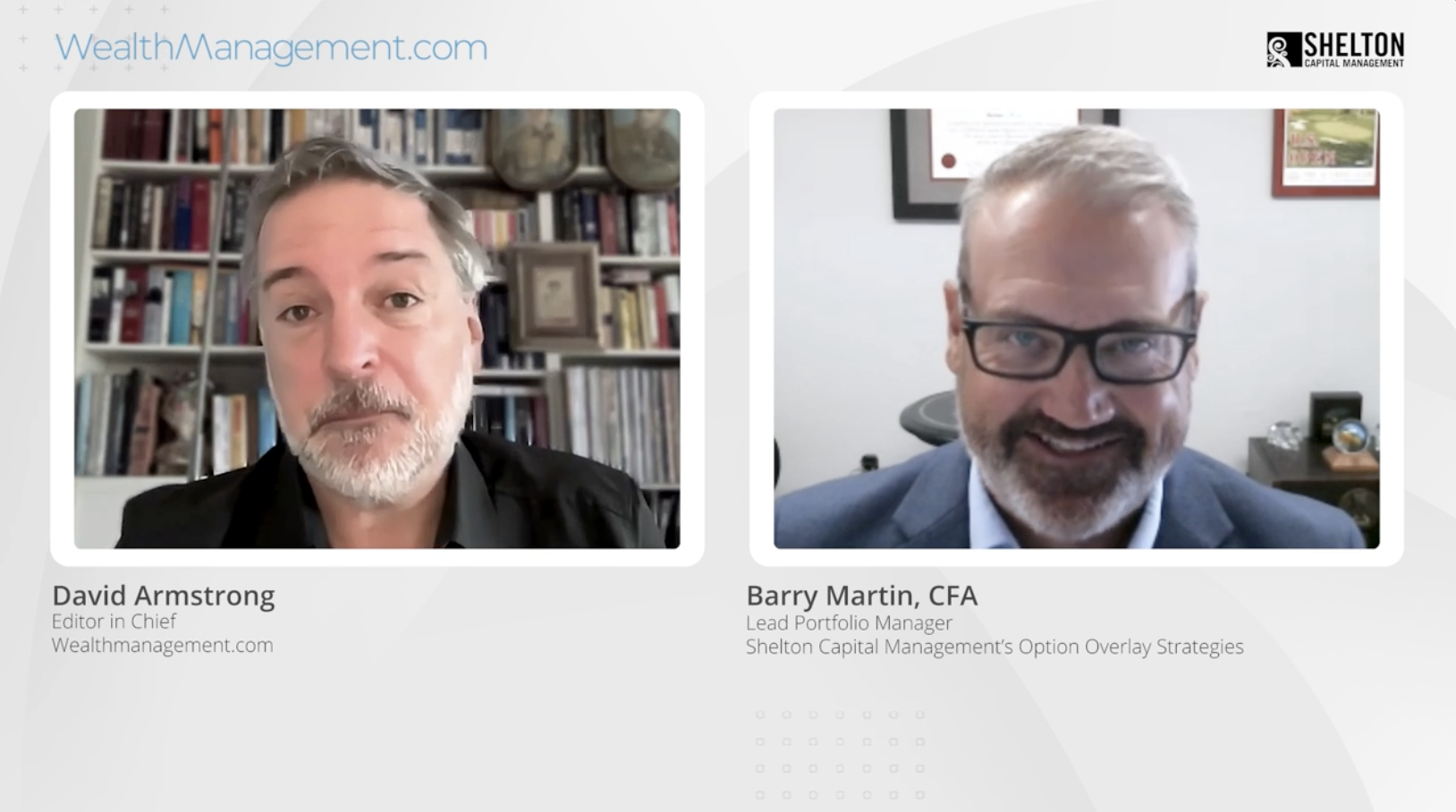
Listen in to Barry Martin, lead portfolio manager at Shelton Capital Management, as he discusses the rise and strategy of covered calls in investment portfolios. Learn the demographic and economic factors driving the popularity of covered calls, highlighting their potential for generating cash flow and diversifying portfolios. This fastchat conversation covers the mechanics of covered calls, and the importance of educating clients about the strategy's nuances.

Shelton Capital Management (SCM) is a boutique investment firm that helps investors meet financial goals through tailored investment solutions and human-centric customer service. Founded in 1985, the company provides mutual funds, ETFs, and separately managed accounts to the clients of wealth managers, retirement plans, and individual investors. As of 8/31/25, the firm manages over $6 billion across fixed income portfolios, U.S. equity and international equity strategies, ESG solutions, and equity income products leveraging our expertise in options. Over the decades, we’ve collected awards from established sources such as Morningstar, Lipper, Forbes Advisor, and Pension & Investments. The company continues to add key employee talent and expand their institutional expertise. Shelton is headquartered in Denver, Colorado with additional offices in San Francisco. For more information, visit www.sheltoncap.com.
Important Information
EQTIX received an Overall Morningstar Rating of 5 stars among 74 Derivative Income funds, based on risk-adjusted returns, as of 6/30/2025. The fund’s Morningstar three-,five-, ten-year ratings respectively, 4 stars, 4 stars, 5 stars among 74, 65, 33 funds. The ETF is not a mutual fund and may not achieve the same result
SCM Trust has filed and declared effective a registration statement with the U.S. Securities and Exchange Commission for the Shelton Equity Premium Income ETF, which is now listed and trading on the NYSE Arca under the ticker symbol SEPI.
The Shelton Equity Premium Income ETF is distributed by Paralel Distributors LLC, Member Firm. Shelton Capital Management is not affiliated with Paralel Distributors LLC, Member FINRA.
- Source: VettFi, “The Hunt for Yield: Enhanced Income ETFs Thrive in a Low-Upside Market.”
- Shelton Options Solutions - Over $2B in AUM as of 8/31/2025.
- Standard deviation is a way to measure how much investment returns move up and down compared to their average.
- The hypothetical example does not represent the returns of any particular investment.
SEPI Fund Disclosures
An investor should consider the investment objectives, risks, charges, and expenses of the Fund carefully before investing. To obtain a prospectus containing this and other information, please call (800) 955-9988 or visit www.sheltoncap.com/sepi. Read the prospectus carefully before investing.
Exchange Traded Funds (“ETFs”) are subject to the possible loss of principal. The value of the ETFs will fluctuate with the value of the underlying securities. ETF Shares may trade at prices above or below NAV. Liquidity isn’t guaranteed, and trading may be halted due to market-wide or security-specific events, delisting, or exchange actions.
The Fund is new with a limited operating history.
The value of the Fund’s equity holdings may decline, sometimes unpredictably, due to broader economic, political, or market conditions not specific to individual companies. Because the Fund is primarily invested in U.S. stocks, its value will fluctuate with overall market movements and may decline during market downturns, potentially resulting in losses. The Fund’s use of call and put options can limit upside potential and increase costs, particularly if market movements render the options ineffective or result in expired contracts without value.
Investments in derivatives may be riskier than other types of investments. They may be more sensitive to changes in economic or market conditions than other types of investments. Many derivatives create leverage, which could lead to greater volatility and losses that significantly exceed the original investment. Positions in equity options can reduce equity market risk, but can limit the opportunity to profit from an increase in the market value of stocks in exchange for upfront cash as the time of selling the call option. Unusual market conditions or the lack of a ready market for any particular option at a specific time may reduce the effectiveness of option strategies and could result in losses.
© 2025 Morningstar, Inc. All rights reserved. The information contained herein relating to Morningstar: (1) is proprietary to Morningstar and/or its content providers; (2) may not be copied or distributed; and (3) is not warranted to be accurate, complete, or timely. Neither Morningstar nor its content providers are responsible for any damages or losses arising from any use of this information. Past performance is no guarantee of future results.
The Morningstar Rating™ for funds, or “star rating”, is calculated for managed products (including mutual funds, variable annuity and variable life subaccounts, exchange-traded funds, closed-end funds, and separate accounts) with at least a three-year history. Exchange-traded funds and open-ended mutual funds are considered a single population for comparative purposes. It is calculated based on a Morningstar Risk-Adjusted Return measure that accounts for variation in a managed product’s monthly excess performance, placing more emphasis on downward variations and rewarding consistent performance. The Morningstar Rating does not include any adjustment for sales loads. The top 10% of products in each product category receive 5 stars, the next 22.5% receive 4 stars, the next
35% receive 3 stars, the next 22.5% receive 2 stars, and the bottom 10% receive 1 star. The Overall Morningstar Rating for a managed product is derived from a weighted average of the performance figures associated with its three-, five-, and 10-year (if applicable) Morningstar Rating metrics. The weights are: 100% three-year rating for 36-59 months of total returns, 60% five-year rating/40% three-year rating for 60-119 months of total returns, and 50% 10-year rating/30% five-year rating/20% three-year rating for 120 or more months of total returns. While the 10-year overall star rating formula seems to give the most weight to the 10-year period, the most recent three-year period actually has the greatest impact because it is included in all three rating periods.
Cash flow is the money generated or available to distribute to shareholders. Distributions may include option premium, ordinary dividends, interest income, capital gains, or return of capital. Distributions may coincide with a decline in NAV. Distribution levels may vary and no minimum distribution amount can be guaranteed.
The statements and opinions expressed here are those of the author. Any discussion of investment strategies represents the author’s views as of the date of the articles and are subject to change without notice.
INVESTMENTS ARE NOT FDIC INSURED OR BANK GUARANTEED AND MAY LOSE VALUE.



A covered call is an options strategy where an investor owns shares of an underlying stock and sells (or “writes”) a call option on that same stock. By selling the call, the investor collects income (called the “premium”) from the option buyer. The "covered" aspect means the investor holds enough shares of the underlying stock to fulfill their obligation if the call option is exercised.